In the English language, many words feel similar in sound and meaning, which creates confusion for learners. The topic continually vs continuously is often hard because both words appear close in pronunciation and meaning, yet they are not the same. This article is made to explain the fine differences between these two words in a straightforward way so readers can easily understand the idea without difficulty.
The concept of homophones and near-similar words makes English more challenging, and even somewhat experienced learners find it difficult to choose the correct word. That is why selecting the appropriate meaning becomes very important in real usage. Additionally, both continually and continuously carry meanings that are somewhat overlapping, which increases confusion when trying to pick the right option.
Once you fully understand the distinction, it becomes more straightforward to decide which word to use in different situations. The two words may still sound close in sound, but their meaning is different, and knowing this helps in making the correct choice every time.
Quick Answer
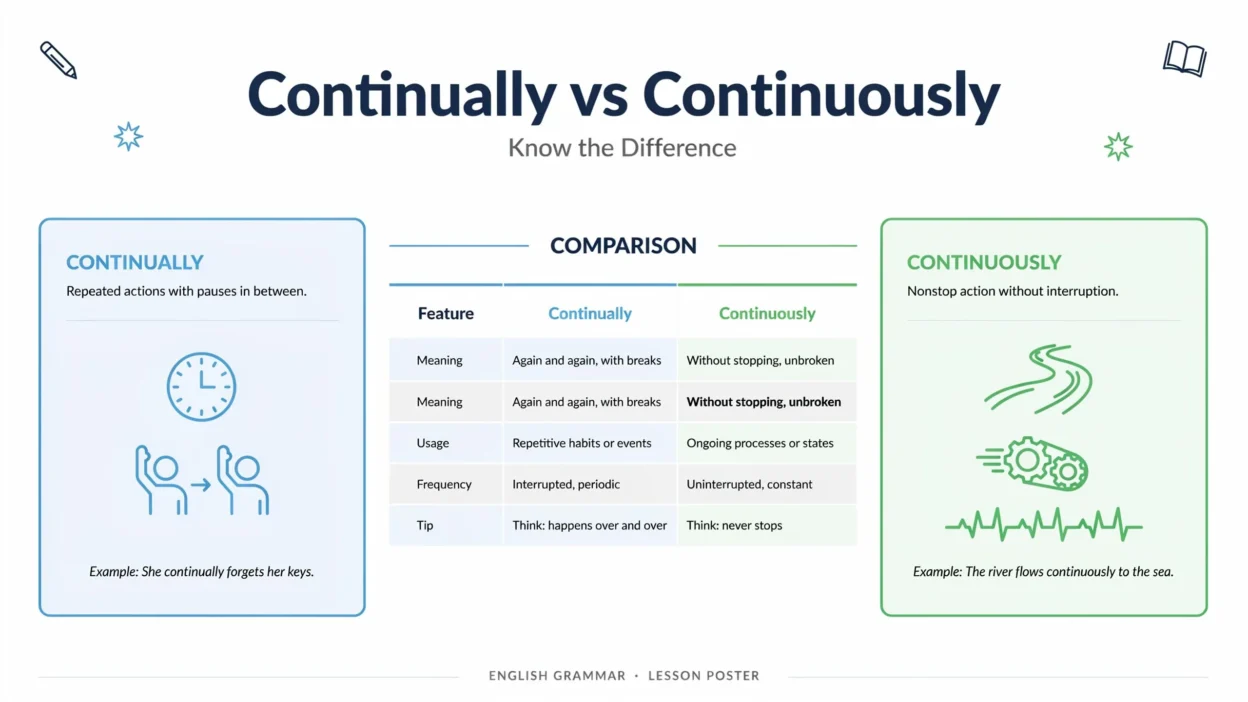
- Continually = something happens again and again, but with breaks in between
- Continuously = something happens without stopping
- Both words talk about repeated action, but the time pattern is different
- Continually = repeated but not nonstop
- Continuously = nonstop action
- The difference is about “breaks vs no breaks”
Origin or Background (Very Simple)
Both words come from the verb continue, which means “to keep going.”
Over time, English created two forms:
- One form to show repeated action (continually)
- One form to show nonstop action (continuously)
| Word | Root Idea |
| Continually | Something keeps happening again and again |
| Continuously | Something keeps going without stopping |
This small change in meaning developed to help people describe time and actions more clearly.
Clear Difference Between Continually and Continuously
The main difference is very simple:
- Continually = repeated action with pauses
- Continuously = nonstop action without breaks
Let’s understand it more deeply.
Continually (Repeated Action)
This word is used when something happens many times, but not all the time.
Examples:
- The phone rang continually during the meeting.
- He was continually asking questions in class.
- She was continually late, but not every single day.
Here, there are small gaps or pauses between actions.
Continuously (Nonstop Action)
This word is used when something happens without stopping.
Examples:
- The machine runs continuously for 24 hours.
- It rained continuously all night.
- The heart beats continuously.
Here, there is no pause or break.
Comparison Table (Easy to Scan)
| Feature | Continually | Continuously |
| Meaning | Repeated actions | Nonstop action |
| Breaks | Yes, breaks exist | No breaks |
| Time pattern | Start and stop | Always ongoing |
| Usage type | Everyday repeated events | Scientific, technical, or constant actions |
| Example idea | Again and again | Without stopping |
| Feeling | Interrupted action | Smooth flow |
| Common use | Daily life situations | Machines, nature, systems |
| Mistake risk | Confusing with continuously | Confusing with continually |
Which One to Use and When
Choosing between these words depends on the type of action.
Use “continually” when:
- Something happens again and again
- There are small breaks
- The action is repeated over time
Example situations:
- Talking in class again and again
- Interruptions during work
- Repeated behavior
Use “continuously” when:
- Something never stops
- There is no break at all
- It is a constant process
Example situations:
- Machines running
- Heart beating
- Rain or sound without stopping
Common Mistakes People Make
Mistake 1: Using them as exact synonyms
| Wrong | Correct |
| It rained continually all night (if no break) | It rained continuously all night |
Mistake 2: Thinking both mean “always”
Not correct. Only continuously means “without stopping.”
Mistake 3: Mixing in writing
| Sentence | Problem |
| The alarm rang continuously for hours but stopped sometimes | Confusing meaning |
Mistake 4: Overusing “continually”
People often use it when they actually mean nonstop action.
Everyday Real-Life Examples
Emails
| Sentence | Word Used |
| The server was running continuously during backup. | Continuously |
| He was continually sending follow-up emails. | Continually |
News
| Sentence | Word Used |
| The river flows continuously through the valley. | Continuously |
| Protesters were continually gathering near the building. | Continually |
Social Media
| Sentence | Word Used |
| My phone keeps buzzing continuously. | Continuously |
| She is continually posting new updates. | Continually |
Daily Life
| Situation | Word |
| A fan running all day | Continuously |
| A child asking questions again and again | Continually |
| Traffic noise without stopping | Continuously |
| Repeated reminders from someone | Continually |
Learning Section for Students
Simple Trick to Remember
- Continually = continues again and again
- Continuously = continues without stop
Fill in the Blanks
- The machine works __________.
- He was __________ interrupting the teacher.
- The clock ticks __________.
- She was __________ late to school.
Answers:
- Continuously
- Continually
- Continuously
- Continually
Quick Practice
| Question | Answer |
| Nonstop action = ? | Continuously |
| Repeated action = ? | Continually |
| Heart beating = ? | Continuously |
| Repeated complaints = ? | Continually |
FAQ
1. What is the main difference between continually and continuously?
Continually means repeated with breaks. Continuously means without breaks.
2. Are they interchangeable?
No, they have different meanings.
3. Which one means nonstop?
Continuously.
4. Which one means repeated actions?
Continually.
5. Is continuously used in science?
Yes, often for processes like heartbeat or motion.
6. Can continually mean always?
Not exactly. It means again and again, not always nonstop.
7. Why are they confusing?
Because they look and sound similar.
8. How can I remember easily?
Think: “continually = repeated”, “continuously = nonstop”.
Conclusion
The difference between continually and continuously is simple once you understand it clearly. One describes repeated actions with breaks, and the other describes nonstop actions without stopping. By remembering this small rule, you can avoid confusion and use both words correctly in speaking and writing.