The terms sub and dom are often seen in online discussions, social media posts, relationship conversations, and popular culture. Because these words are usually shortened forms of longer terms, many people become confused about what they actually mean.
Some people think a sub is weak and a dom is always controlling. Others believe the terms only apply to romantic relationships. In reality, these ideas are often misunderstood.
This guide explains sub vs dom in very simple English. Whether you are a student, learner, beginner, or general reader, this article will help you understand the difference clearly and confidently.
Quick Answer
| Term | Simple Meaning |
| Sub | A person who prefers to follow or receive guidance in a power-exchange relationship |
| Dom | A person who prefers to lead or take responsibility in a power-exchange relationship |
Key Points
| Sub | Dom |
| Often follows agreed guidance | Often provides agreed guidance |
| May enjoy receiving direction | May enjoy giving direction |
| Makes choices and gives consent | Makes choices and respects consent |
| Not weaker than a dom | Not more important than a sub |
| Has personal boundaries | Has personal boundaries |
Easy Rule
- Sub = follows agreed leadership
- Dom = provides agreed leadership
Where Do These Terms Come From?
The words are short forms of longer terms.
| Short Form | Full Word |
| Sub | Submissive |
| Dom | Dominant |
These words became common in discussions about relationship dynamics and power exchange.
The important thing to understand is that these roles are based on agreement, trust, communication, and respect.
Neither role is automatically better than the other.
What Is a Sub?
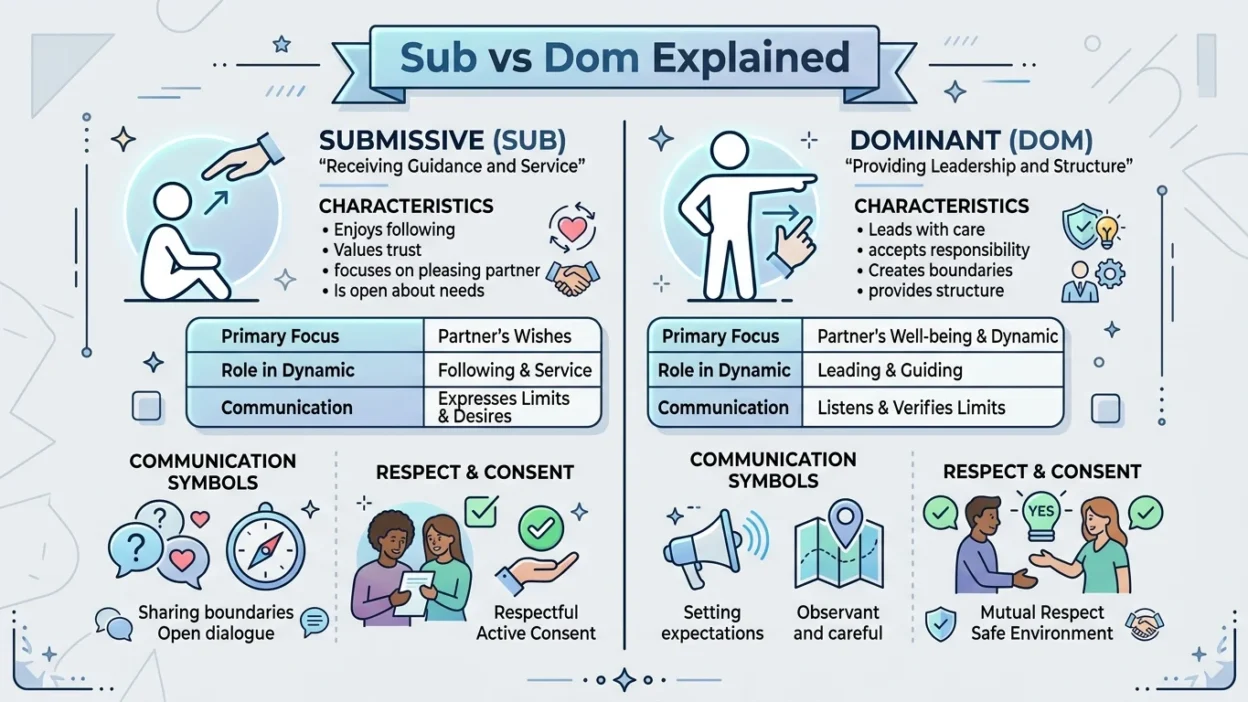
A sub is short for submissive.
A submissive person may enjoy letting another person take the lead in certain situations or parts of a relationship.
Common Characteristics
| Sub Traits |
| May prefer guidance |
| Often values trust |
| Communicates boundaries |
| Makes personal choices |
| Participates willingly |
Being a sub does not mean:
| Myth | Reality |
| A sub is weak | A sub can be confident and strong |
| A sub has no say | A sub always has a voice |
| A sub loses control completely | A sub keeps personal rights and boundaries |
What Is a Dom?
A dom is short for dominant.
A dominant person may enjoy taking leadership or responsibility within an agreed relationship dynamic.
Common Characteristics
| Dom Traits |
| Provides direction |
| Takes responsibility |
| Respects boundaries |
| Communicates clearly |
| Builds trust |
Being a dom does not mean:
| Myth | Reality |
| A dom can do anything they want | Respect and consent are required |
| A dom is always aggressive | Many doms are calm and caring |
| A dom is more important | Both roles are equally valuable |
The Main Difference Between Sub and Dom
The biggest difference is the role each person prefers in an agreed dynamic.
| Feature | Sub | Dom |
| Main Role | Follows agreed leadership | Provides agreed leadership |
| Preference | Receiving direction | Giving direction |
| Responsibility | Communicates needs | Communicates expectations |
| Decision Making | May allow guidance in some areas | May take the lead in some areas |
| Boundaries | Has boundaries | Respects boundaries |
| Importance | Equal value | Equal value |
| Trust Required | Yes | Yes |
| Communication Needed | Yes | Yes |
The relationship works best when both people understand and respect each other.
Detailed Comparison Table
| Area | Sub | Dom |
| Meaning | Submissive role | Dominant role |
| Leadership Style | Follows | Leads |
| Communication | Shares limits and preferences | Shares expectations and responsibilities |
| Trust | Important | Important |
| Consent | Required | Required |
| Respect | Required | Required |
| Relationship Value | Equal | Equal |
| Decision Role | May follow agreed decisions | May guide agreed decisions |
| Personal Rights | Maintains rights | Maintains rights |
| Boundaries | Has boundaries | Honors boundaries |
| Confidence Level | Can be high | Can be high |
| Personality Type | Varies by person | Varies by person |
Which One Should You Use and When?
There is no universal answer.
Different people feel comfortable in different roles.
You May Prefer a Sub Role If
| Situation |
| You enjoy following guidance |
| You feel comfortable letting someone lead in agreed situations |
| You like clear direction |
| You enjoy structured roles |
You May Prefer a Dom Role If
| Situation |
| You enjoy leadership |
| You like taking responsibility |
| You feel comfortable guiding others |
| You enjoy organizing plans and decisions |
Some People Prefer Both
A person may enjoy different roles at different times.
| Role Type | Meaning |
| Switch | Someone who may enjoy both roles depending on the situation |
Common Mistakes People Make
1. Thinking a Sub Is Weak
| Incorrect Idea | Correct Idea |
| Subs are weak | Subs can be strong, confident, and independent |
2. Thinking a Dom Is a Boss
| Incorrect Idea | Correct Idea |
| Doms control everything | Healthy dynamics require agreement and respect |
3. Believing One Role Is Better
| Incorrect Idea | Correct Idea |
| One role matters more | Both roles are equally important |
4. Ignoring Communication
Many beginners focus only on labels.
The real foundation is communication, trust, and understanding.
5. Assuming Everyone Fits One Role
Not everyone identifies as a sub or dom.
Many people prefer relationships without either label.
Everyday Examples
Example in Social Media
Person A: “I identify more as a sub.”
Person B: “I usually prefer a dom role.”
Example in an Online Discussion
“People often misunderstand what being a sub or dom actually means.”
Example in a Relationship Conversation
“We talked about our preferences and discovered that one of us prefers a dom role and the other prefers a sub role.”
Example in a News Story
“Experts emphasize communication and mutual respect when discussing relationship dynamics.”
Example in Daily Conversation
“I learned that sub and dom roles are based on personal preference, not strength or weakness.”
Learning Section for Students and Beginners
Easy Memory Trick
| Word | Memory Tip |
| Sub | Think: receives guidance |
| Dom | Think: gives guidance |
Quick Reminder
| Question | Answer |
| Is a sub weak? | No |
| Is a dom more important? | No |
| Are both equal? | Yes |
| Is communication important? | Yes |
| Is consent important? | Yes |
Mini Quiz
- What does sub stand for?
- Submissive
- What does dom stand for?
- Dominant
- Is one role better than the other?
- No
- What is most important?
- Communication, trust, and respect
FAQs
1. What does sub mean?
Sub is short for submissive. It refers to someone who may prefer following agreed leadership within a relationship dynamic.
2. What does dom mean?
Dom is short for dominant. It refers to someone who may prefer providing agreed leadership within a relationship dynamic.
3. Is a sub weaker than a dom?
No. A person’s role does not determine their strength, intelligence, or confidence.
4. Is a dom always in charge?
Not necessarily. Healthy dynamics depend on communication, agreement, and mutual respect.
5. Can someone be both a sub and a dom?
Yes. Some people enjoy both roles and may switch depending on the situation.
6. Are these roles only used in romantic relationships?
They are most commonly discussed in relationship contexts, but the ideas of leadership and following can appear in many forms of human interaction.
7. Do all relationships have a sub and a dom?
No. Many relationships do not use these roles at all.
8. What matters most in any relationship?
Trust, communication, respect, honesty, and clear boundaries.
Conclusion
The difference between sub and dom is simple once you understand the basic idea. A sub generally prefers following agreed leadership, while a dom generally prefers providing agreed leadership.
The most important thing to remember is that neither role is better, stronger, or more valuable than the other.
| Sub | Dom |
| Receives guidance | Provides guidance |
| Has boundaries | Respects boundaries |
| Communicates needs | Communicates expectations |
| Equal value | Equal value |
When people understand these terms correctly, much of the confusion disappears. At the center of every healthy dynamic are communication, trust, consent, and mutual respect.