Many people get confused by agitator and impeller because both are used to move water or liquid inside machines. You may see these terms when talking about washing machines, industrial tanks, mixers, or pumps. Since both help liquids move, many people think they are the same thing.
However, an agitator and an impeller work in different ways. Understanding the difference is important if you are buying a washing machine, studying engineering basics, or simply trying to learn how machines work.
This guide explains everything in very simple English so that students, beginners, and ESL learners can understand the difference easily.
Quick Answer
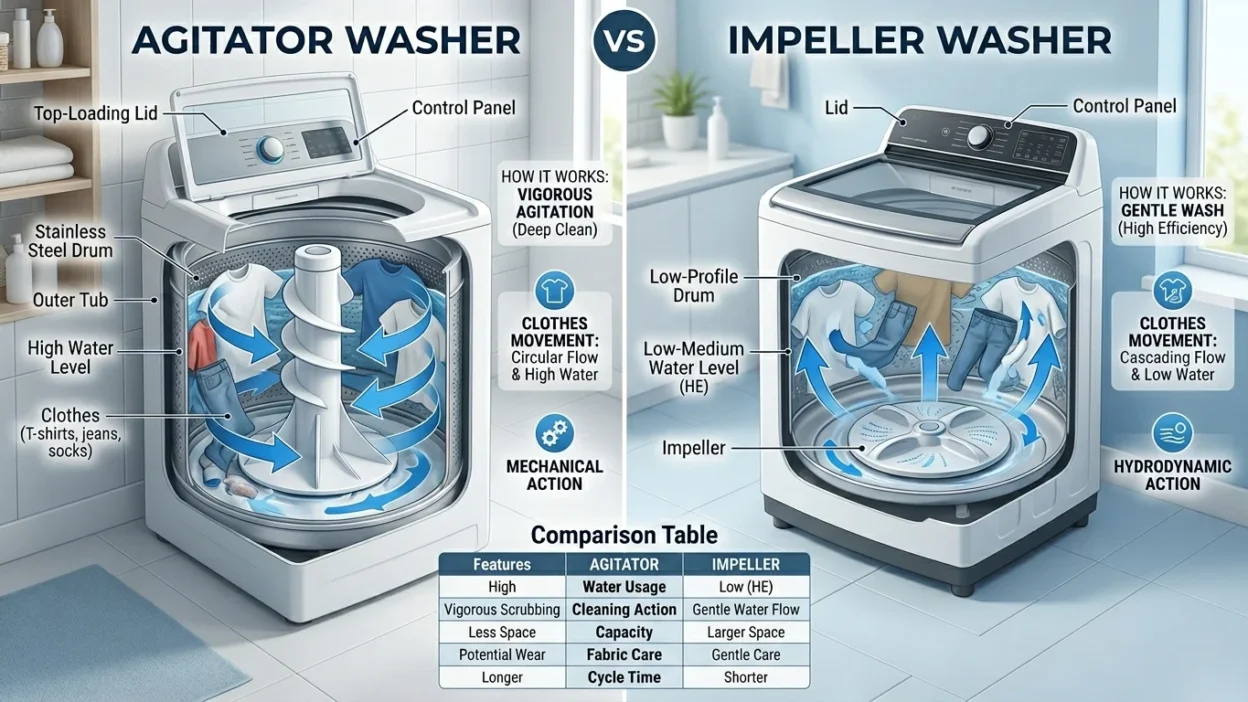
| Agitator | Impeller |
| A device that twists and moves liquid or clothes back and forth | A device that spins to create water flow |
| Usually has a central post | Usually looks like a low-profile disc or cone |
| Common in traditional top-load washing machines | Common in modern high-efficiency washers |
| Uses strong movement | Uses gentle circulating movement |
| Takes up more space inside the machine | Leaves more room inside the machine |
| Often cleans heavily soiled items well | Often saves water and energy |
Simple Rule
- Agitator = twists and pushes
- Impeller = spins and circulates
Understanding the Background
The words come from different ideas.
| Word | Basic Meaning |
| Agitator | Something that stirs, shakes, or moves things around |
| Impeller | Something that drives or pushes liquid forward |
Long before modern washing machines, factories used agitators to mix liquids and materials. Later, engineers developed impellers to move liquids more smoothly and efficiently.
Today, both designs are used in different machines depending on the job that needs to be done.
What Is an Agitator?
An agitator is a part placed in the center of a machine or tank. It moves back and forth or twists around.
Main Purpose
Its job is to:
- Stir materials
- Move clothes through water
- Break up dirt and stains
- Keep materials mixed together
What Does It Look Like?
Most washing machine agitators:
- Stand upright in the center
- Have fins or blades
- Rotate in different directions
How It Works
| Step | Action |
| 1 | Machine fills with water |
| 2 | Agitator starts moving |
| 3 | Clothes move around the agitator |
| 4 | Dirt loosens from fabric |
| 5 | Cleaning process continues |
The movement is often strong and powerful.
What Is an Impeller?
An impeller is usually a low-profile rotating plate, cone, or disc at the bottom of a machine.
Main Purpose
Its job is to:
- Create water currents
- Move liquid efficiently
- Circulate water around items
- Reduce energy use
What Does It Look Like?
Most impellers:
- Sit at the bottom
- Do not have a tall center post
- Have small fins or ridges
How It Works
| Step | Action |
| 1 | Machine fills with water |
| 2 | Impeller spins |
| 3 | Water currents form |
| 4 | Clothes move through water |
| 5 | Dirt is washed away |
Instead of directly rubbing clothes, the water movement does most of the cleaning.
Agitator vs Impeller: Main Differences
Comparison Table
| Feature | Agitator | Impeller |
| Design | Tall center post | Flat disc or cone |
| Location | Center of machine | Bottom of machine |
| Movement | Twists and turns | Spins rapidly |
| Cleaning Style | Direct action | Water-flow action |
| Water Use | Usually more | Usually less |
| Energy Use | Usually higher | Usually lower |
| Load Capacity | Smaller | Larger |
| Space Available | Less room | More room |
| Wear on Clothes | Can be greater | Usually gentler |
| Heavy Dirt Removal | Very good | Good |
| Delicate Fabrics | Less ideal | Often better |
| Noise Level | Can be louder | Often quieter |
| Modern Popularity | Traditional design | Modern design |
| Efficiency | Lower in many cases | Higher in many cases |
| Maintenance | Simple | Simple |
| Best For | Tough stains and heavy loads | Daily washing and efficiency |
How Their Movement Differs
| Agitator Movement | Impeller Movement |
| Pushes clothes directly | Pushes water directly |
| Creates strong friction | Creates water circulation |
| Clothes move around a center post | Clothes move in water currents |
| Strong mechanical action | Smooth flowing action |
| More aggressive cleaning | More gentle cleaning |
This movement difference is the easiest way to remember them.
Which One Should You Use and When?
The answer depends on your needs.
Choose an Agitator When
| Situation | Reason |
| Work clothes are very dirty | Strong cleaning action |
| Sports uniforms need deep cleaning | Better stain removal |
| Mud and heavy dirt are common | Powerful movement |
| You prefer traditional washers | Familiar design |
Choose an Impeller When
| Situation | Reason |
| You wash large loads | More space available |
| You want water savings | Uses less water |
| You want energy savings | More efficient |
| You wash delicate clothes | Gentler movement |
| You need more capacity | No center post |
Advantages and Disadvantages
Agitator
| Advantages | Disadvantages |
| Strong cleaning power | Uses more water |
| Good for heavy dirt | Less space |
| Traditional design | May be rough on fabrics |
| Often shorter wash cycles | Higher energy use in some models |
Impeller
| Advantages | Disadvantages |
| More room for clothes | May need longer wash cycles |
| Water efficient | Heavy stains may need extra treatment |
| Energy efficient | Different washing style may take getting used to |
| Gentler on fabrics | Some users prefer agitator cleaning action |
Common Mistakes People Make
1. Thinking They Are the Same Thing
Many people use the words interchangeably.
Correct: They perform similar jobs but use different methods.
2. Believing an Impeller Does Not Clean Well
Some people think only agitators clean effectively.
Correct: Modern impellers can clean very well while using less water.
3. Assuming Agitators Are Always Better
Strong movement is not always better.
Correct: The best choice depends on the type of clothes and washing needs.
4. Thinking Impellers Have No Moving Parts
An impeller still rotates and moves water.
Correct: It simply uses a different design than an agitator.
Everyday Real-Life Examples
Example in a Store
Customer: “Does this washer have an agitator?”
Salesperson: “No, it uses an impeller system.”
Example on Social Media
“My new impeller washer fits more clothes than my old agitator washer.”
Example in a News Article
“Many newer washing machines use impeller technology to improve efficiency.”
Example at Home
Parent: “Use the agitator washer for the muddy soccer uniforms.”
Example in a Conversation
Friend A: “Why is there more room inside this washer?”
Friend B: “Because it uses an impeller instead of an agitator.”
Learning Section for Students and Beginners
A simple memory trick can help.
| Word | Memory Tip |
| Agitator | Think of “agitate” = shake or stir |
| Impeller | Think of “impel” = push forward |
Easy Formula
| Device | Main Action |
| Agitator | Moves clothes |
| Impeller | Moves water |
Quick Quiz
- Which one usually has a center post?
- Answer: Agitator
- Which one creates water currents?
- Answer: Impeller
- Which one usually provides more washing space?
- Answer: Impeller
- Which one often provides stronger direct cleaning action?
- Answer: Agitator
FAQ
1. Is an agitator the same as an impeller?
No. An agitator moves clothes directly, while an impeller mainly moves water.
2. Which cleans better?
Both can clean well. Agitators are often stronger for very dirty clothes, while impellers focus on efficient cleaning.
3. Which uses less water?
Impellers generally use less water.
4. Which gives more room inside a washing machine?
Impellers usually provide more space because there is no tall center post.
5. Are impellers newer than agitators?
Yes. Impeller systems became popular in many modern high-efficiency machines.
6. Which is gentler on clothes?
Impellers are often gentler because they rely more on water movement.
7. Can an impeller handle large loads?
Yes. Many impeller washers are designed for larger loads.
8. Which is better for heavily soiled work clothes?
An agitator is often preferred for very dirty items because of its stronger movement.
Conclusion
The difference between agitator and impeller is mainly about how they move things inside a machine. An agitator uses a central post that twists and pushes clothes directly, while an impeller uses a rotating plate that creates water currents to move clothes.
In simple terms:
| Agitator | Impeller |
| Moves clothes directly | Moves water directly |
| Stronger action | Gentler action |
| Less space | More space |
| Traditional design | Modern efficient design |
If you need powerful cleaning for heavily soiled items, an agitator may be the better choice. If you want more space, better efficiency, and gentler fabric care, an impeller may be the better option.