If you are learning English, you have probably wondered about saw vs seen. These two words look similar, sound related, and come from the same verb, see. Because of that, many students and English learners use them incorrectly. You might hear someone say, “I seen him yesterday,” while another person says, “I saw him yesterday.” Both sentences seem similar, but only one is correct in standard English.
The confusion happens because both words talk about something connected to the past. However, they do not do the same job in a sentence. One can stand alone, while the other usually needs help from another verb. The good news is that the difference is very easy to learn. Once you understand a simple grammar rule, you will know exactly when to use saw and when to use seen.
This guide explains everything in clear and simple English with examples, tables, and easy memory tricks.
Quick Answer
Here is the short answer:
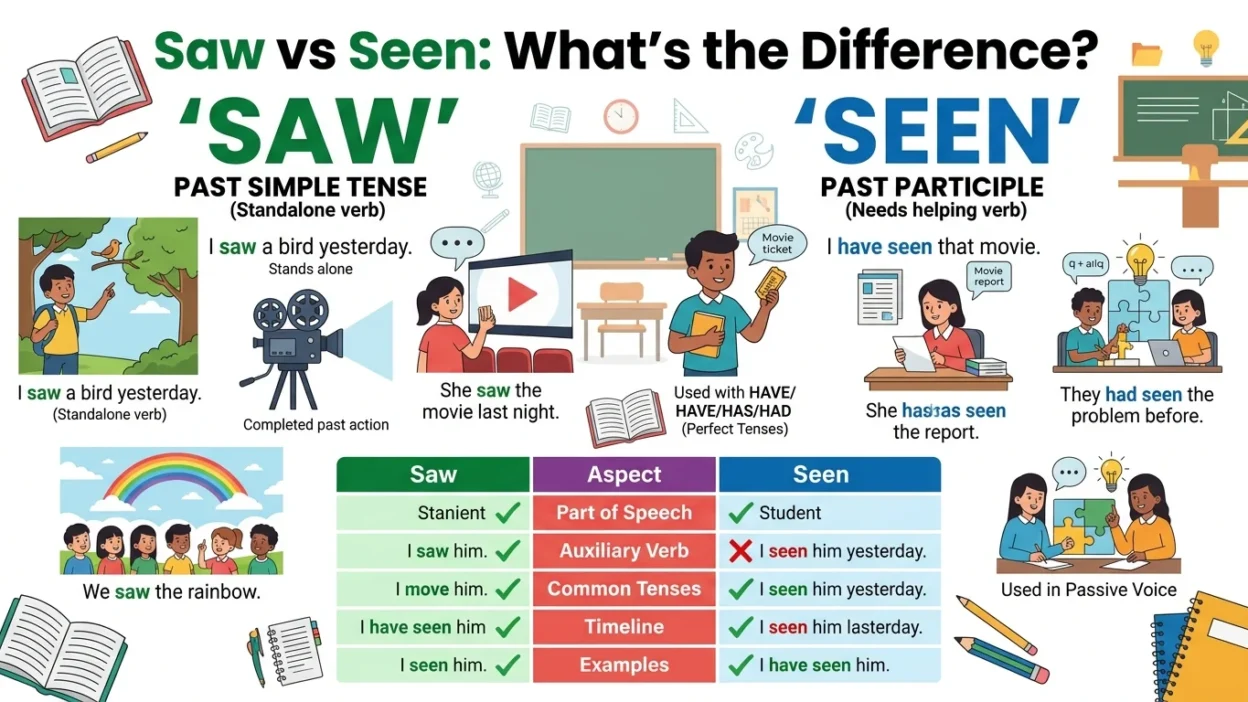
- Saw is the simple past tense of see.
- Seen is the past participle of see.
- Saw can be used by itself.
- Seen usually needs a helping verb such as have, has, or had.
- If there is no helping verb, use saw.
- If there is a helping verb, use seen.
Quick Examples
| Correct | Incorrect |
| I saw him yesterday. | I seen him yesterday. |
| We saw the movie last night. | We seen the movie last night. |
| I have seen that movie. | I have saw that movie. |
| She has seen the report. | She has saw the report. |
Where Do Saw and Seen Come From?
Both words come from the verb see.
Like many English verbs, see changes its form depending on the tense.
| Verb Form | Word |
| Base Form | See |
| Present Tense | See |
| Past Tense | Saw |
| Past Participle | Seen |
| Continuous Form | Seeing |
Here are some examples:
| Tense | Example |
| Present | I see a bird. |
| Past | I saw a bird. |
| Present Perfect | I have seen a bird. |
| Continuous | I am seeing a bird. |
Learning these forms makes it much easier to understand the difference between saw and seen.
Understanding the Difference Between Saw and Seen
The main difference is simple.
Saw is used for a completed action in the past.
Seen is used with helping verbs and is part of perfect tenses.
Think of it this way:
Saw Works Alone
Examples:
- I saw the game yesterday.
- She saw a rainbow.
- We saw your message.
Seen Needs Help
Examples:
- I have seen the game before.
- She has seen a rainbow many times.
- We had seen the message earlier.
A useful memory trick is:
Saw stands alone. Seen needs a friend.
That friend is usually:
- Have
- Has
- Had
Saw vs Seen Comparison Table
| Feature | Saw | Seen |
| Verb Type | Past tense | Past participle |
| Comes From | See | See |
| Can Stand Alone? | Yes | No |
| Needs a Helping Verb? | No | Yes |
| Common Helpers | None | Have, Has, Had |
| Used for Past Actions | Yes | Sometimes |
| Used in Perfect Tenses | No | Yes |
| Example | I saw it. | I have seen it. |
| Common Mistake | Have saw | Seen without helper |
Which One Should You Use and When?
Understanding when to use each word becomes easier if you look at the sentence structure.
Use Saw
Use saw when talking about something that happened at a specific time in the past.
Examples:
- I saw him yesterday.
- We saw the concert last week.
- She saw the teacher this morning.
- They saw the accident last night.
Common Time Words Used With Saw
| Time Expression | Example |
| Yesterday | I saw him yesterday. |
| Last week | We saw her last week. |
| Last year | They saw Paris last year. |
| This morning | I saw your email this morning. |
Use Seen
Use seen when it follows a helping verb.
Examples:
- I have seen that movie.
- She has seen the report.
- We had seen the problem before.
- They have seen the results.
Common Patterns
| Pattern | Example |
| Have seen | I have seen it. |
| Has seen | She has seen it. |
| Had seen | They had seen it. |
| Have never seen | We have never seen snow. |
Common Mistakes People Make
Many learners make the same mistakes because saw and seen both relate to the past.
Mistake #1
❌ I seen him yesterday.
✅ I saw him yesterday.
Mistake #2
❌ Have you saw that movie?
✅ Have you seen that movie?
Mistake #3
❌ She has saw the report.
✅ She has seen the report.
Mistake #4
❌ We seen the accident.
✅ We saw the accident.
Mistake #5
❌ They had saw it before.
✅ They had seen it before.
Quick Correction Table
| Wrong | Right |
| I seen it. | I saw it. |
| Have you saw it? | Have you seen it? |
| She has saw it. | She has seen it. |
| We seen him. | We saw him. |
Everyday Real-Life Examples
Learning grammar becomes easier when you see it in real situations.
In Emails
| Example |
| I saw your email this morning. |
| I have seen your message. |
| She has seen the attachment. |
| We saw the update yesterday. |
In News Reports
| Example |
| Witnesses saw the event. |
| Experts have seen similar cases before. |
| Reporters saw heavy traffic. |
| Officials have seen the evidence. |
On Social Media
| Example |
| I saw that post yesterday. |
| Have you seen this video? |
| We saw the announcement online. |
| Millions have seen the clip already. |
In Daily Conversation
| Example |
| I saw your brother today. |
| Have you seen my keys? |
| She saw a beautiful sunset. |
| We have seen that place before. |
Learning Section for Students and Beginners
Here is a simple way to remember everything.
Step 1
Look for a helping verb.
Step 2
If you see have, has, or had, use seen.
Step 3
If there is no helping verb and the action happened in the past, use saw.
Easy Memory Chart
| Situation | Word to Use |
| Past action | Saw |
| Have + ___ | Seen |
| Has + ___ | Seen |
| Had + ___ | Seen |
| Yesterday | Saw |
| Last week | Saw |
Practice
Choose the correct word.
| Sentence | Answer |
| I _____ him yesterday. | Saw |
| She has _____ the movie. | Seen |
| We _____ a rainbow. | Saw |
| They have _____ the video. | Seen |
| He _____ the teacher today. | Saw |
| I had _____ that before. | Seen |
FAQs
1. Is “I seen him yesterday” correct?
No. The correct sentence is:
I saw him yesterday.
2. Can seen be used by itself?
Usually no.
It normally needs a helping verb such as have, has, or had.
3. What is the past tense of see?
The past tense of see is saw.
Example:
I saw a movie yesterday.
4. What is the past participle of see?
The past participle is seen.
Example:
I have seen that movie.
5. Which is correct: “Have you saw” or “Have you seen”?
The correct form is:
Have you seen?
6. Why do people confuse saw and seen?
Because both words come from the verb see and both relate to past actions.
7. Is “She has seen the report” correct?
Yes.
The pattern has + seen is correct.
8. Is “She has saw the report” correct?
No.
The correct sentence is:
She has seen the report.
Conclusion
The difference between saw and seen is easier than many learners think.
Remember these simple rules:
| Rule | Example |
| Saw is the past tense | I saw him yesterday. |
| Seen is the past participle | I have seen him before. |
| Saw can stand alone | She saw the movie. |
| Seen needs have, has, or had | She has seen the movie. |
Whenever you feel confused, check the sentence for a helping verb. If you see have, has, or had, use seen. If the action happened in the past and there is no helping verb, use saw. Once you remember this simple rule, using saw and seen correctly becomes much easier in everyday speaking and writing.