The confusion around persue vs pursue often begins when learners hear the word spoken, but English spelling follows rules that do not always match pronunciation exactly. The word pursue carries a long history, a clear meaning, and flexible usage in both everyday and proper English. People pursue dreams, build knowledge, and work toward personal goals, making this an important word to understand correctly.
One reason many people continue to misspell it is that they focus on sound rather than structure. As you learn the correct pattern, it becomes easier to recognize mistakes and remember the right form. I have noticed that students improve much faster when they stop guessing and start paying attention to how the word appears in real writing.
Using simple memory tricks can make the difference between writing persue and writing pursue correctly every time. Reading real-life examples in books, articles, and messages helps reinforce the correct spelling and shows its natural usage in different situations. The more often you see the word in context, the more familiar it becomes.
Another helpful method is to review the word regularly and connect it with personal goals for the future. When you explore the spelling deeply, the incorrect form becomes easier to recognize and spot instantly, allowing the correct version to feel more natural over time.
Quick Answer
| Question | Answer |
| Is “persue” a correct English word? | No |
| Is “pursue” a correct English word? | Yes |
| Which spelling should you use? | Pursue |
| Why do people write “persue”? | Because it sounds similar to pursue |
| Is “persue” found in standard dictionaries? | No |
| Is “pursue” used in formal writing? | Yes |
Simple Rule
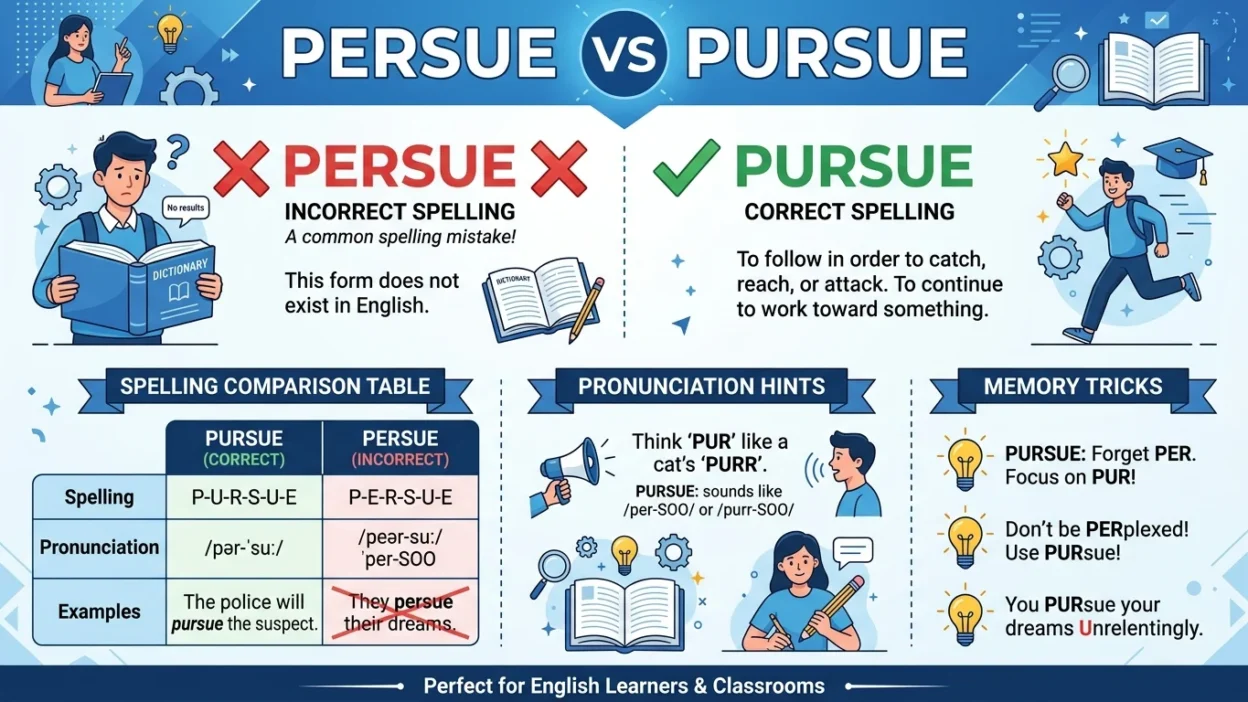
- ✅ Pursue = Correct spelling
- ❌ Persue = Incorrect spelling
Examples
| Correct | Incorrect |
| Pursue your goals. | Persue your goals. |
| She wants to pursue medicine. | She wants to persue medicine. |
| We should pursue the opportunity. | We should persue the opportunity. |
Where Does the Confusion Come From?
English spelling does not always match pronunciation perfectly.
When people hear the word spoken, they often think it sounds like per-sue. Because of this, many writers accidentally add an extra “e” after “p.”
| What People Hear | What They Write |
| Per-sue | Persue |
| Pur-sue | Pursue |
The problem is that English spelling follows historical patterns rather than sound alone.
That is why pursue became the accepted spelling.
What Does Pursue Mean?
The word pursue is a verb.
It means:
| Meaning | Example |
| To follow a goal | Pursue your dreams. |
| To continue doing something | She pursued her studies. |
| To try to achieve something | They pursued success. |
| To follow someone or something | The police pursued the suspect. |
Common Things People Pursue
| Examples |
| Dreams |
| Knowledge |
| Education |
| Careers |
| Success |
| Opportunities |
| Happiness |
| Goals |
Persue vs Pursue: The Main Difference
The difference is actually very easy.
| Feature | Persue | Pursue |
| Correct English spelling | No | Yes |
| Found in standard dictionaries | No | Yes |
| Accepted in school writing | No | Yes |
| Accepted in business writing | No | Yes |
| Accepted in exams | No | Yes |
| Real English word | No | Yes |
| Should you use it? | No | Yes |
Key Point
There is not a difference in meaning because persue is simply a misspelling of pursue.
Comparison Table
Side-by-Side Comparison
| Category | Persue | Pursue |
| Word Type | Misspelling | Verb |
| Grammar Status | Incorrect | Correct |
| Dictionary Entry | No | Yes |
| Academic Writing | Not accepted | Accepted |
| Professional Writing | Not accepted | Accepted |
| Everyday Writing | Mistake | Correct |
| Pronunciation | Intended to sound like pursue | Correct pronunciation |
| Usage | Avoid | Use |
| Meaning | None | Follow, continue, achieve |
| Recommendation | Never use | Always use |
Which One Should You Use and When?
The answer is simple.
Always Use “Pursue”
| Situation | Correct Usage |
| School essays | Pursue |
| Emails | Pursue |
| News articles | Pursue |
| Social media posts | Pursue |
| Business reports | Pursue |
| Applications | Pursue |
| Everyday writing | Pursue |
Never Use “Persue”
| Situation | Recommendation |
| Formal writing | Avoid |
| Academic work | Avoid |
| Professional communication | Avoid |
| Personal writing | Avoid |
Common Mistakes People Make
1. Writing Based on Sound
Many learners spell words exactly as they hear them.
| What Happens | Result |
| Hear “per-sue” | Write persue |
| Learn correct spelling | Write pursue |
2. Typing Too Quickly
Fast typing often causes spelling mistakes.
| Incorrect | Correct |
| Persue | Pursue |
| Persuing | Pursuing |
| Persued | Pursued |
3. Assuming Both Spellings Are Acceptable
Some people think both versions are correct.
| Statement | True or False |
| Persue is correct. | False |
| Pursue is correct. | True |
| Both are accepted. | False |
4. Ignoring Spell Check Warnings
Most writing tools flag persue as an error.
Checking your work can prevent this mistake.
Everyday Real-Life Examples
Email Example
✅ “I would like to pursue this opportunity.”
❌ “I would like to persue this opportunity.”
Social Media Example
✅ “Never stop pursuing your dreams.”
❌ “Never stop persuing your dreams.”
News Example
✅ “The company plans to pursue new markets.”
❌ “The company plans to persue new markets.”
School Example
✅ “She wants to pursue a degree in engineering.”
❌ “She wants to persue a degree in engineering.”
Daily Conversation Example
Person A: “What do you want to do after graduation?”
Person B: “I want to pursue a career in medicine.”
Learning Section for Students and Beginners
Easy Memory Trick #1
Look at the beginning of the word:
PUR-sue
The correct spelling starts with pur.
Easy Memory Trick #2
Think of these words:
| Word | Correct? |
| Pure | Yes |
| Purpose | Yes |
| Pursue | Yes |
| Persue | No |
Easy Memory Trick #3
Remember this sentence:
“I pursue my purpose.”
Both words start with pur.
Mini Practice Quiz
| Question | Answer |
| Which spelling is correct? | Pursue |
| Is persue a real English word? | No |
| Which spelling belongs in an essay? | Pursue |
| Which spelling belongs in a business email? | Pursue |
FAQs
1. Is persue a real English word?
No. It is a spelling mistake.
2. Is pursue the correct spelling?
Yes. Pursue is the standard English spelling.
3. Why do people write persue?
Because the pronunciation can make people think there should be an extra “e.”
4. What does pursue mean?
It means to follow, continue, seek, or try to achieve something.
5. Can I use persue in formal writing?
No. You should always use pursue.
6. Is pursue a verb?
Yes. Pursue is a verb.
7. What are common things people pursue?
People pursue dreams, education, careers, knowledge, success, and opportunities.
8. How can I remember the correct spelling?
Remember the phrase: “Pursue your purpose.” Both words begin with pur.
Conclusion
The confusion between persue and pursue is common, but the answer is very simple. Pursue is the correct spelling, while persue is an incorrect spelling that should be avoided.
| Remember This | Answer |
| Correct spelling | Pursue |
| Incorrect spelling | Persue |
| Use in writing | Pursue |
| Use in exams | Pursue |
| Use in emails | Pursue |
| Use in daily English | Pursue |
Once you remember that pursue starts with pur, you can avoid this mistake and write with more confidence.